
Learn / Bind
3 min read
Why the inner pages of a zine stick out
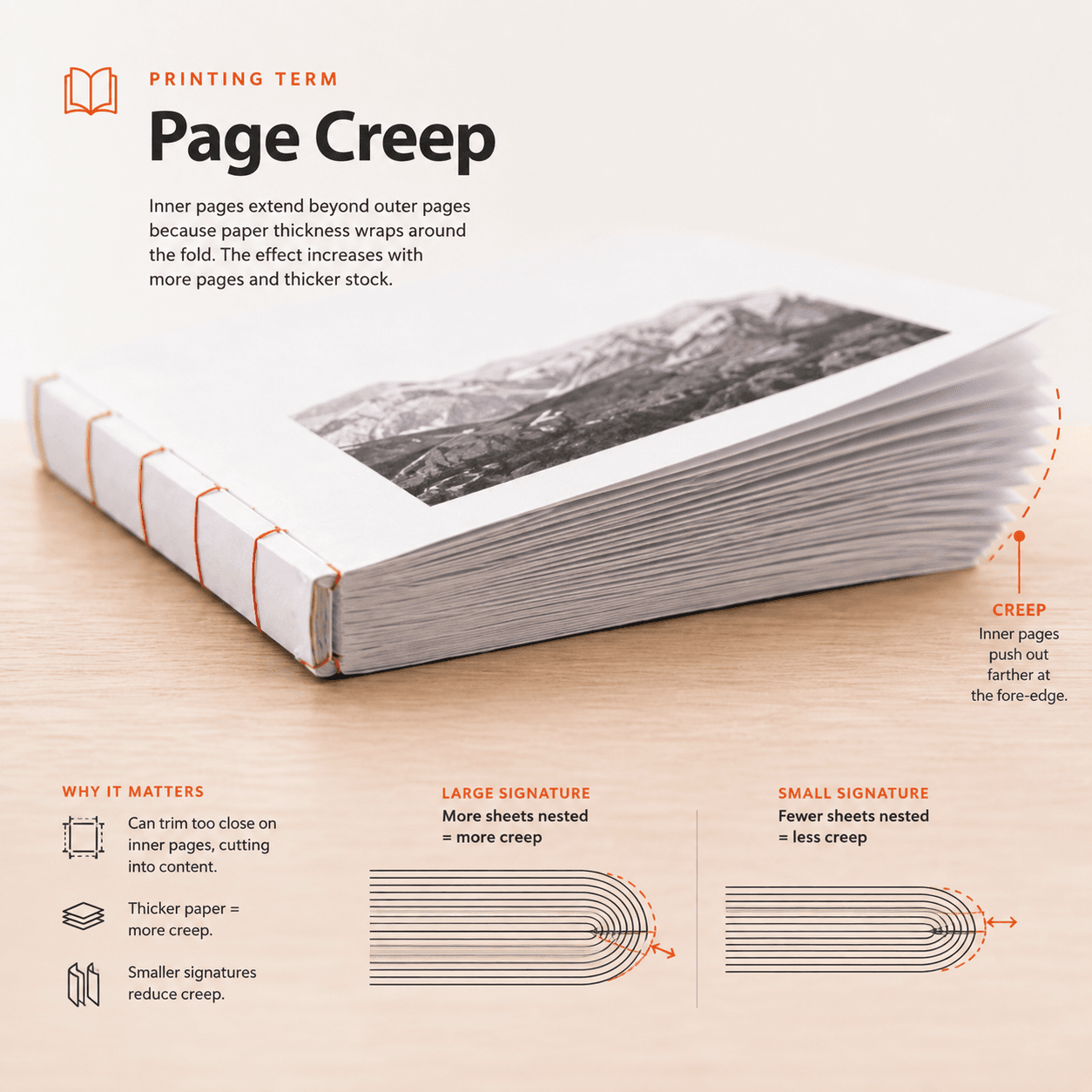
Creep is one of those print terms that sounds abstract until you hold a thick folded booklet and notice the inner pages sticking farther out than the outer ones. Once you see it, a lot of trimming decisions make more sense.
In plain English
Creep is one of those print terms that sounds abstract until you hold a thick folded booklet and notice the inner pages sticking farther out than the outer ones.
What this guide covers
- 01Creep comes from paper thickness wrapping around the fold
- 02Why it matters in real zines
- 03Paper thickness changes the size of the problem
- 04Smaller signatures reduce creep
Creep comes from paper thickness wrapping around the fold
In a nested folded booklet, every inner sheet has to travel around the thickness of the sheets outside it. That makes the inner pages extend slightly farther at the fore-edge.
The more sheets you nest into one folded unit, the more that outward shift accumulates.
Why it matters in real zines
If you ignore creep, the trimmed fore-edge can cut closer and closer to the content on inner pages. Page numbers, borders, and image detail can end up feeling uneven from the front of the booklet to the center.
On small thin zines the effect can be minor. On thicker folded books it becomes obvious quickly.
Paper thickness changes the size of the problem
A bulky paper stock produces more creep than a thinner sheet at the same page count, because each wrap around the fold adds more thickness.
That is why page count alone is not enough. Two books with the same number of pages can behave differently if the stock changes.
Smaller signatures reduce creep
Breaking a large book into multiple signatures limits the number of sheets nested in any one folded section. That keeps the push-out inside each signature more manageable.
This is one reason signatures are not just a sewing choice. They are also a way to keep trimming and page geometry under control.
Creep planning reference
The key question is not whether creep exists, but how much paper thickness is accumulating inside one folded unit.
| Situation | Creep effect | What to do |
|---|---|---|
Thin short booklet | Small push-out | Check it, but trimming may stay modest |
Thick single signature | Strong inner-page push-out | Increase trim awareness or split into signatures |
Multiple smaller signatures | Reduced creep per section | Keep each folded unit manageable |
Creep is a physical result of nesting folded sheets. It is not a software bug, and it does not disappear just because the file looks neat on screen.
This table shows a worked example of how the concept affects real sheet order, page order, or production decisions.
Common mistakes
Assuming equal trim margins stay equal after folding
Once sheets nest, the inner pages physically shift outward even if the digital margins started the same.
Thinking only page count matters
Paper thickness changes creep too, so the same page total can behave differently on different stocks.
Treating signatures as only a binding style preference
They also reduce the number of sheets nested per section, which directly helps control creep.
Plan the folded structure before the trim surprises you
Kumizine’s manufacturing guidance already estimates creep for folded structures, so you can spot risky thickness before you print and trim the real job.
Could this guide be better?
If something is unclear, incomplete or incorrect, suggest a specific improvement.
Suggest an improvement →Editorial provenance
How this guide is maintained
- Written and reviewed by
- the Kumizine team
- Last reviewed
- 2026-08-24
What we check before we publish or update technical guidance
- •We compare the explanation against the same production rules Kumizine uses for page order, signatures, and print-planning where those rules apply.
- •We keep practical guidance tied to supported workflows rather than describing imaginary bindings, printer behaviour, or export features.
- •When a guide needs a worked example, we prefer first-party booklet, template, or layout examples taken from Kumizine’s own workflows.
Corrections and feedback
If something here is unclear, outdated, or technically wrong, tell us. We use that feedback to correct the guide instead of silently letting drift build up.
Contact Kumizine